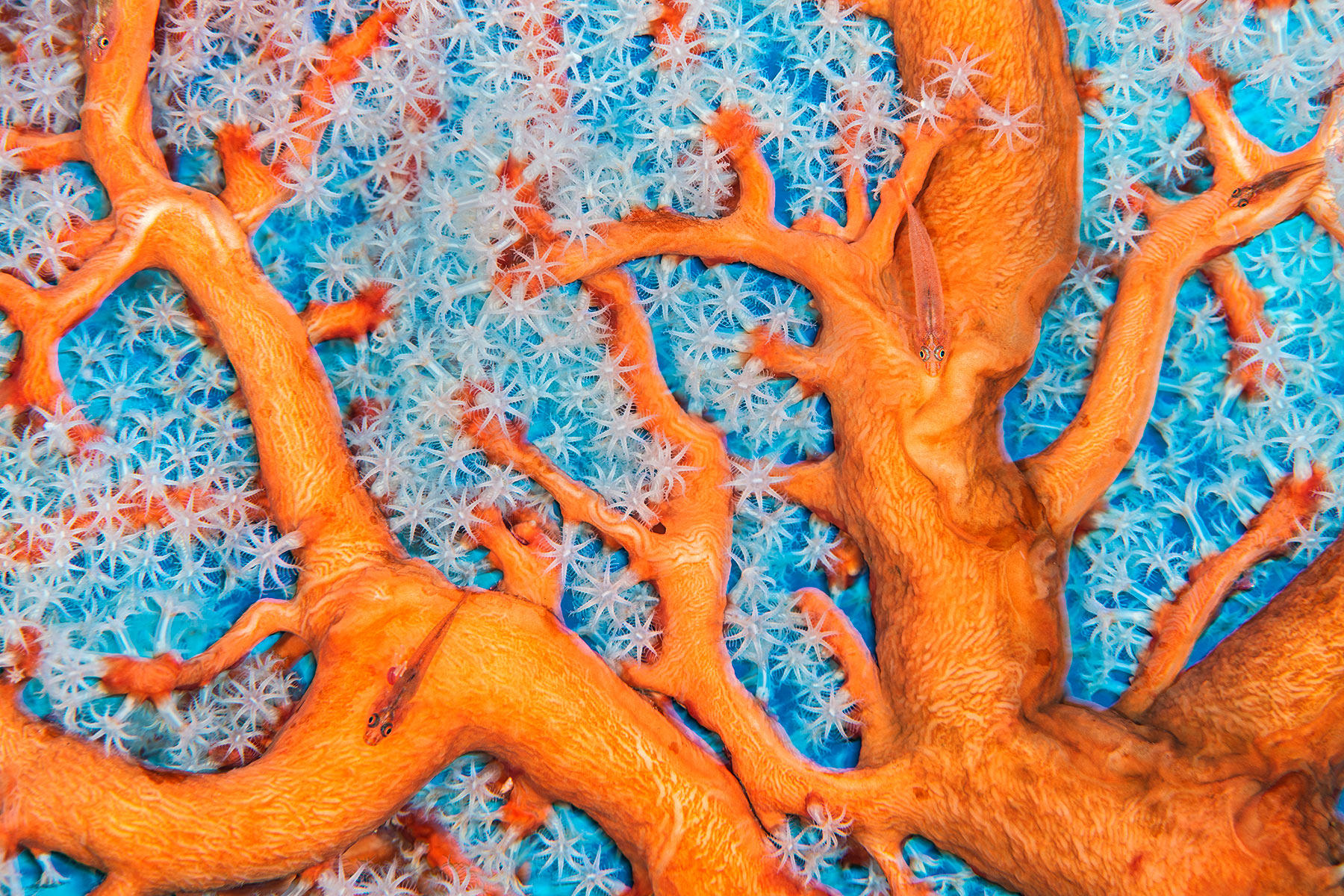
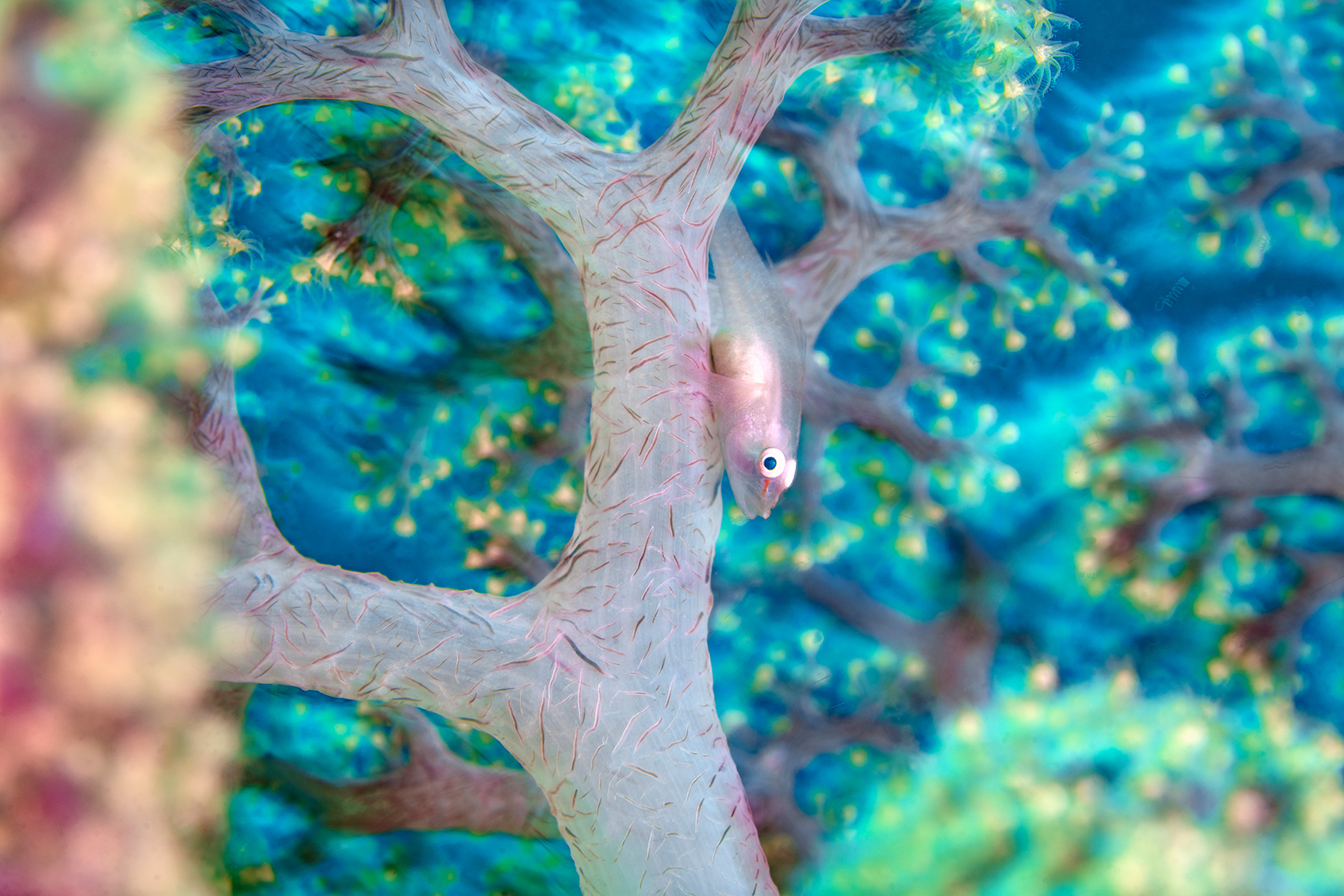
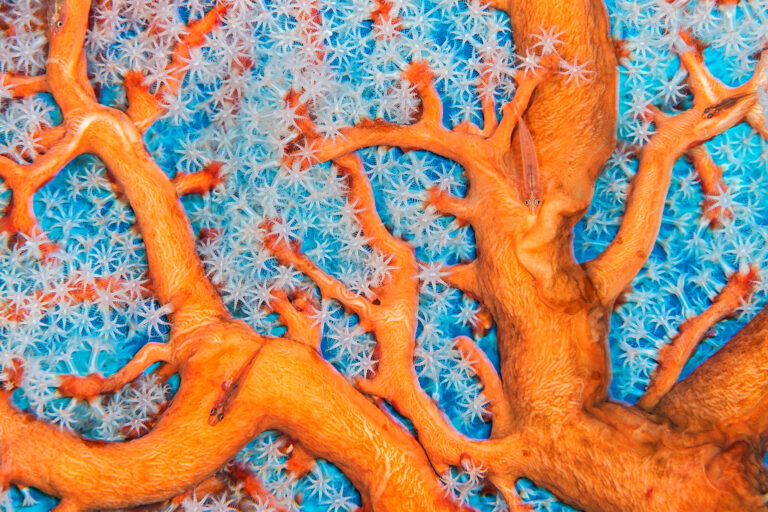
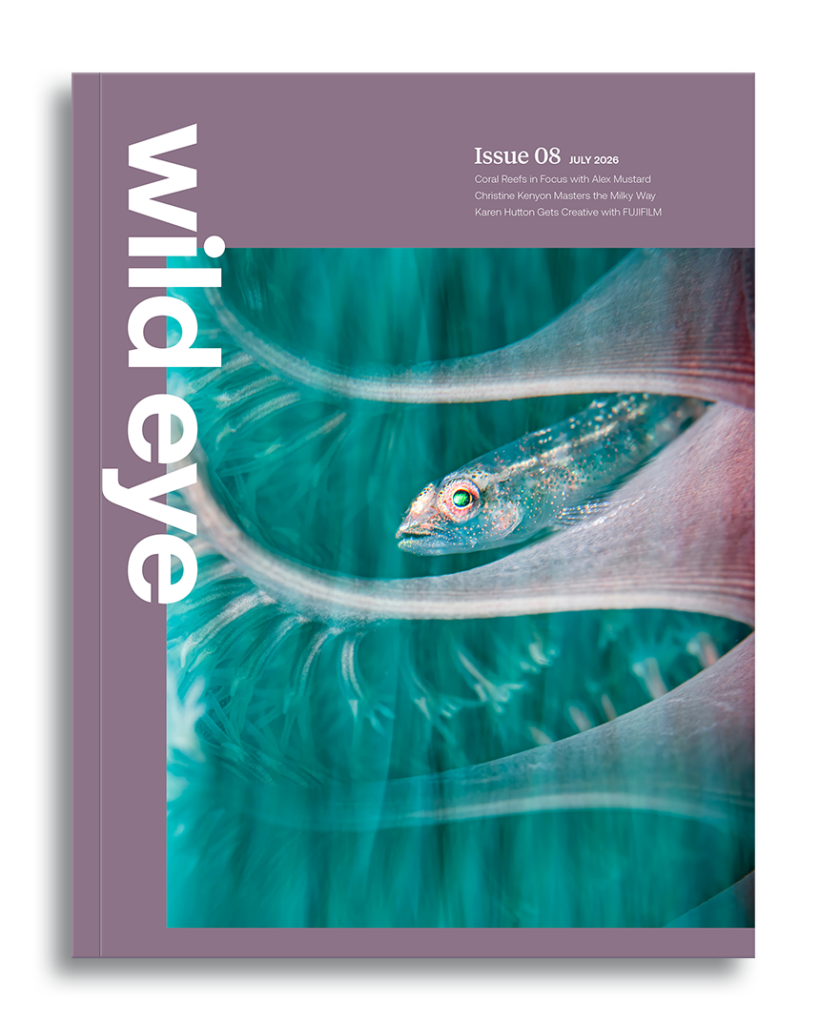
Lembeh Strait, Sulawesi, Indonesia Ghost gobies make their home, almost unnoticed, on the branches of a vibrant seafan. Look closer and spot a small crab and a copepod parasite in a goby.
↑ Lembeh Strait, Sulawesi, Indonesia Ghost gobies make their home, almost unnoticed, on the branches of a vibrant seafan. Look closer and spot a small crab and a copepod parasite in a goby.
Cities of Life
Words and Images by Dr. Alex Mustard
I approach the seafan for a closer look, lured in by its outrageous golden-orange hue. The gaps between the glowing branches are so packed with delicate white, eight-armed polyps that I struggle to comprehend where they can all attach.
A tiny, translucent ghost goby darts down one of the branches, then freezes, attempting to resume its hidden life. It’s tiny, like the tip of a cotton bud, but on its side is a parasitic copepod with two spirals of eggs winding out of its carapace.
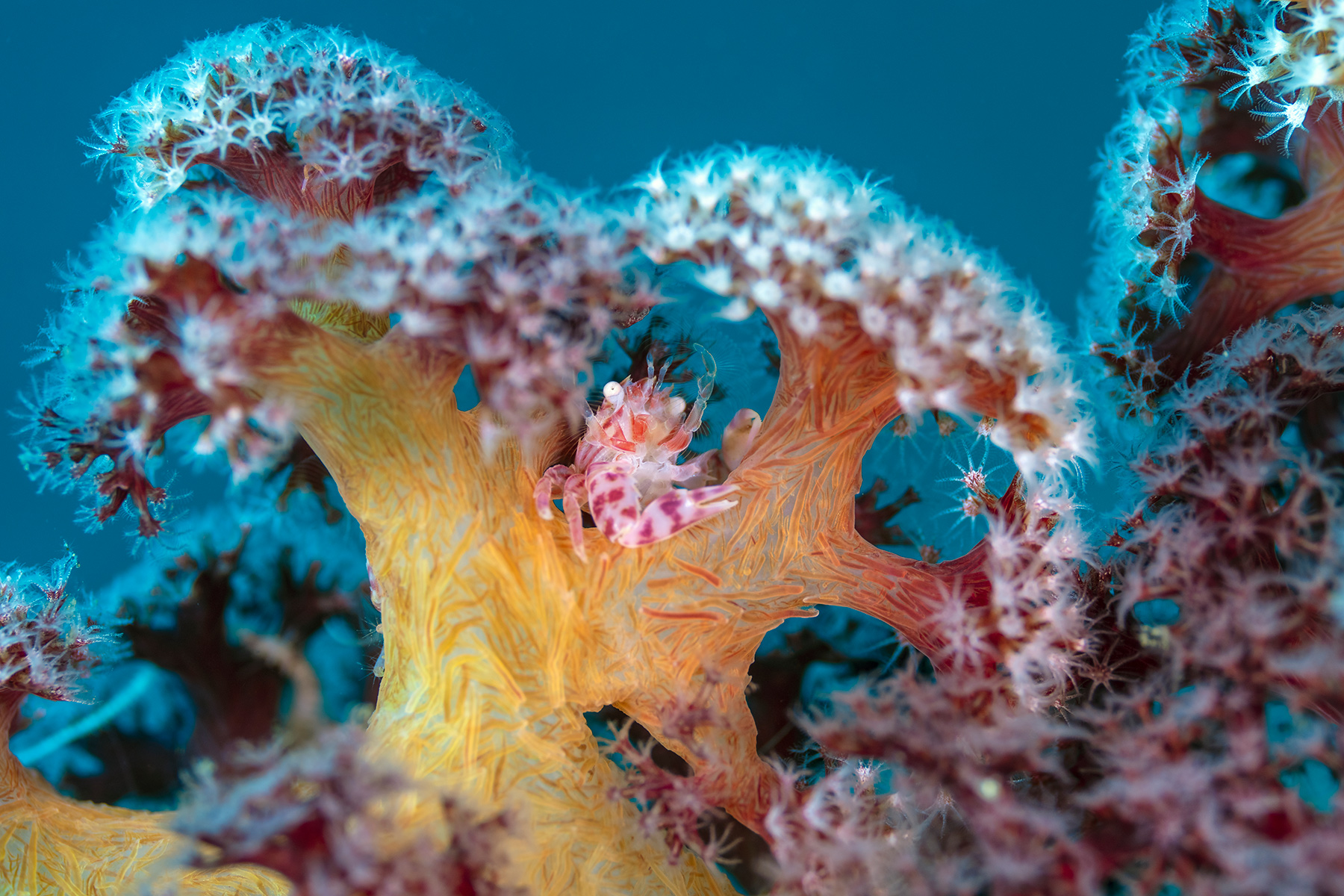
Nearby, I spot a porcelain crab clinging to one of the branches, fanning out its jointed appendages to filter food from the flow of the ocean, a couple more ghost gobies, and then the eyes of a glass shrimp as it scuttles through the polyps. It’s a tiny world of animals, vertebrates, and invertebrates, living out their lives in an area smaller than a postcard. A microcosm of symbioses that define coral reefs and allow them to support so many species in a small space.
Lembeh Strait, Sulawesi, Indonesia The closer you look, the more you see. A four-lobed porcelain crab extends its feeding arms to strain plankton while nestled in the nook of a soft coral.
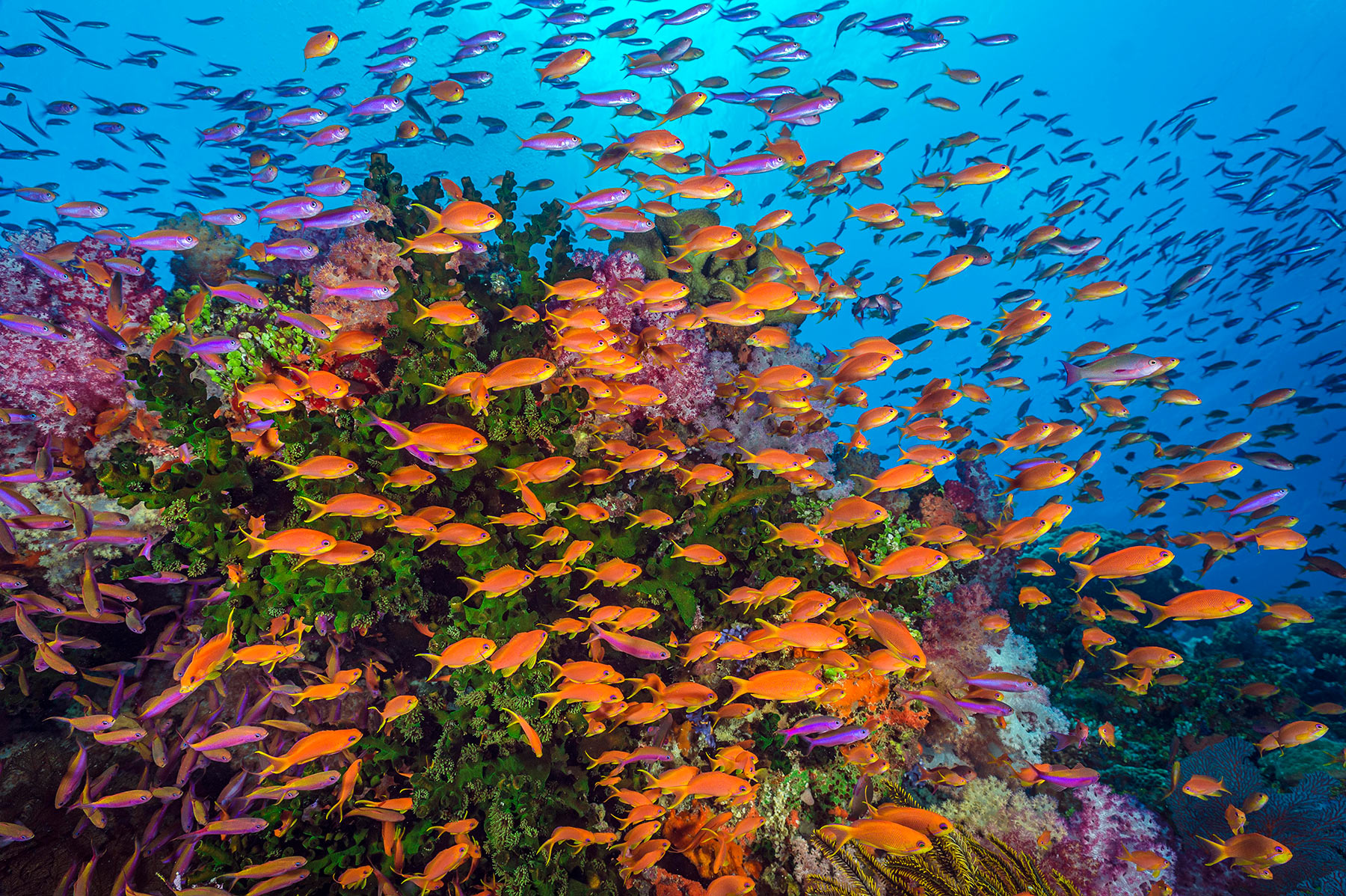
I back away and more of the reef fills my view. A group of purple anthias parade by — sponges, sea squirts, hydroids, soft corals, and hard corals all competing for space on every surface. A vermillion grouper dotted in sky blue is lurking below an overhang, and streams of schooling blue and yellow fusiliers flow above. This is animal life expressed in movement, color, abundance, and diversity on Earth.
Vatu-i-Ra Conservation Park, Fiji At first glance, a coral reef is a blizzard of color and movement. Scalefin anthias and magenta slender anthias stream in front of green coral.
The most recent global study says coral reefs provide goods and services worth roughly $2.7 trillion per year.
More Than Rainforests
Many people say that coral reefs are the “rainforests of the sea,” but I’ve always felt that rather undersells them. Whenever I’ve visited rainforests, I’ve seen a lot of green, but found animal life takes an expert eye to glimpse. Coral reefs bombard your senses with an onslaught of animal variety and abundance.
All living animals are classified into one of 34 phyla, the broadest taxonomic groups, each representing a fundamentally different morphological way of being an animal. The more phyla present in an ecosystem, replace with the following to fix the orphan “the more genetic and species diversity will be present.
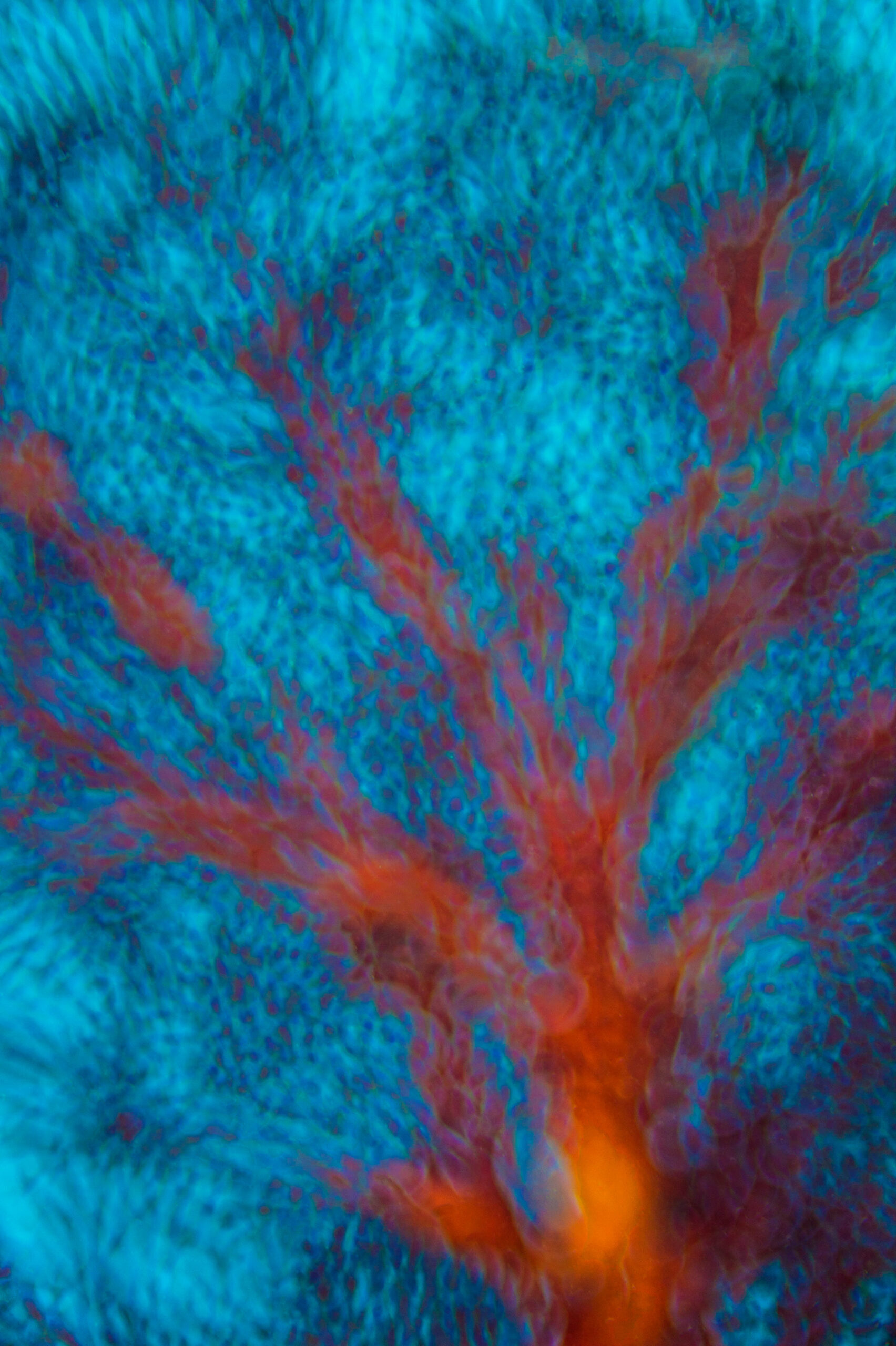
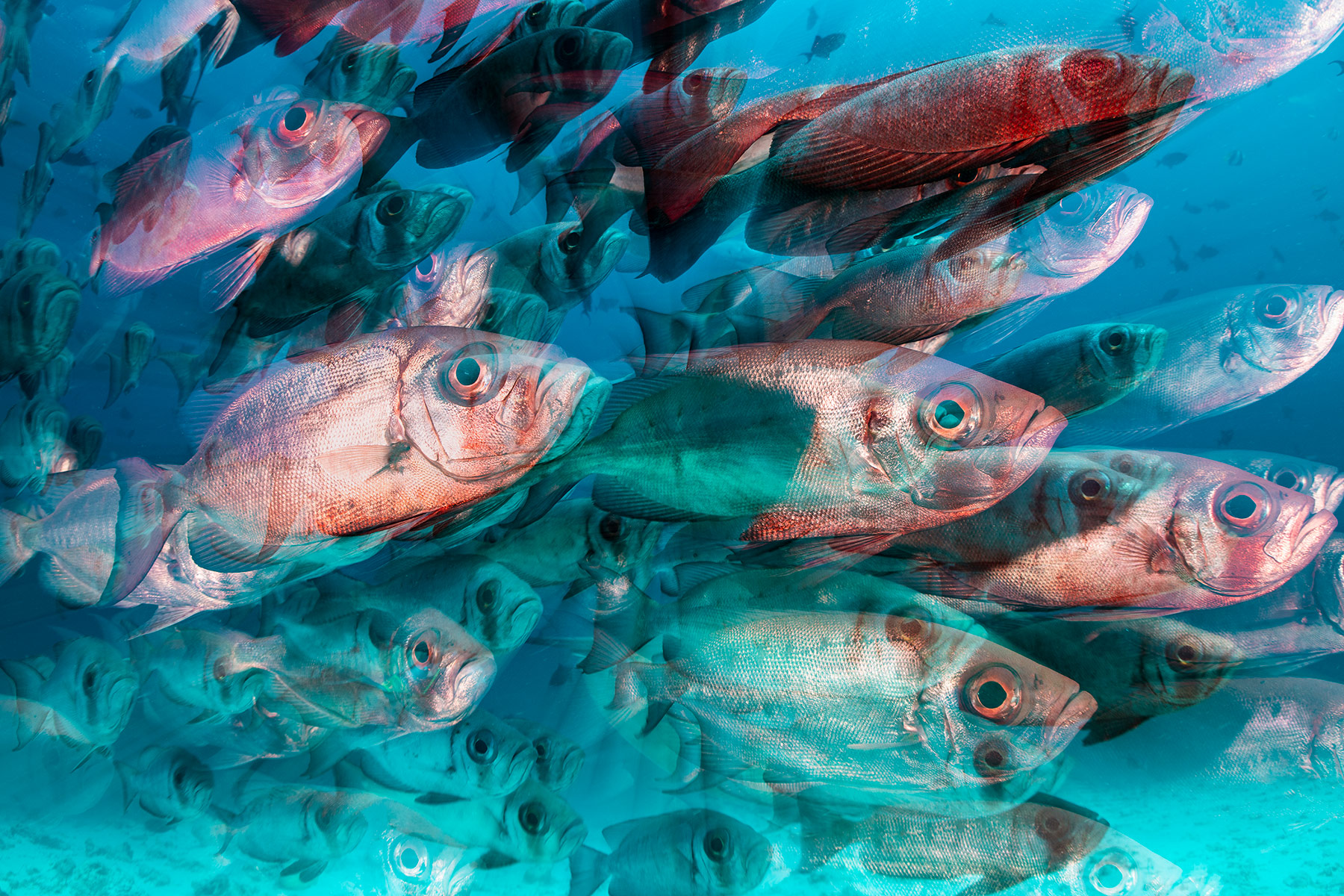
Vatu-i-Ra Conservation Park, Fiji Reefs are characterized by both expansive structures and complex details. Sea fans spread out to fill every gap so they can trap every particle of food the currents waft through their branches. Rendered here in an impressionistic style using a vintage camera lens.
Rainforests cover an area 20 times greater than coral reefs, and in all their trees, soil, air, and leaf litter, we can find animals from nine phyla. If we add the life in the rivers that flow through the rainforests, we can push this number to 17. Coral reefs support 32 phyla.
We shouldn’t be surprised because ocean life has had time on its side. Multicellular animal life started evolving in the ocean about a billion years before it did on land. Modern coral reefs only cover about 1% of the ocean floor, yet they support at least a quarter of all marine species. This incredible concentration of diversity makes them clearly the most valuable biological systems we share the planet with.
Nature’s Hidden Value
Reefs silently serve humanity in a host of ways. Across more than a hundred countries, coral reefs act as living breakwaters. In addition to protecting coastlines, the reefs provide food and create employment and income through healthy fishing practices and tourism dollars. The most recent global study says coral reefs provide goods and services worth roughly $2.7 trillion per year in the form of coastal protection, fisheries, tourism, and even biomedical compounds found in the reef biodiversity.
There isn’t one reason why reefs brim with life, but we can start to put the pieces together by zooming out and looking at our planet’s patterns of biodiversity. Biodiversity typically peaks in places with lots of energy, space, and time. On land, species numbers are greatest in the humid tropics where the sun’s energy and water are abundant. In the ocean, the biodiversity hotspots are finer-grained, influenced in part by currents and upwelling, but most critically, the availability of shallow water energized by the power of sunlight.
Komodo National Park, Indonesia Extreme specialization and the structural complexity allow so much life to co-exist in a tiny area. Reefs are home to hundreds of goby species. This type of ghost goby lives only within the branches of soft corals.
Reefs don’t cover much of the ocean, but they deliver space through habitat complexity unmatched by any other ecosystem. Reefs are characterized by a three-dimensional framework of walls, pinnacles, caverns, canyons, spurs, buttresses, boulders, plates, and branches. Such intricate structures multiply biological niches and, therefore, species numbers.
Masters of Symbiosis
The reef’s architecture is built on a partnership: Coral polyps are tiny animals that cohabit with microscopic photosynthetic housemates, the zooxanthellae. These microalgae live symbiotically within the coral, converting sunlight and carbon dioxide into sugars, passing as much as 90% to their hosts. This energy windfall helps corals construct entire landscapes in waters where nutrients are scarce.
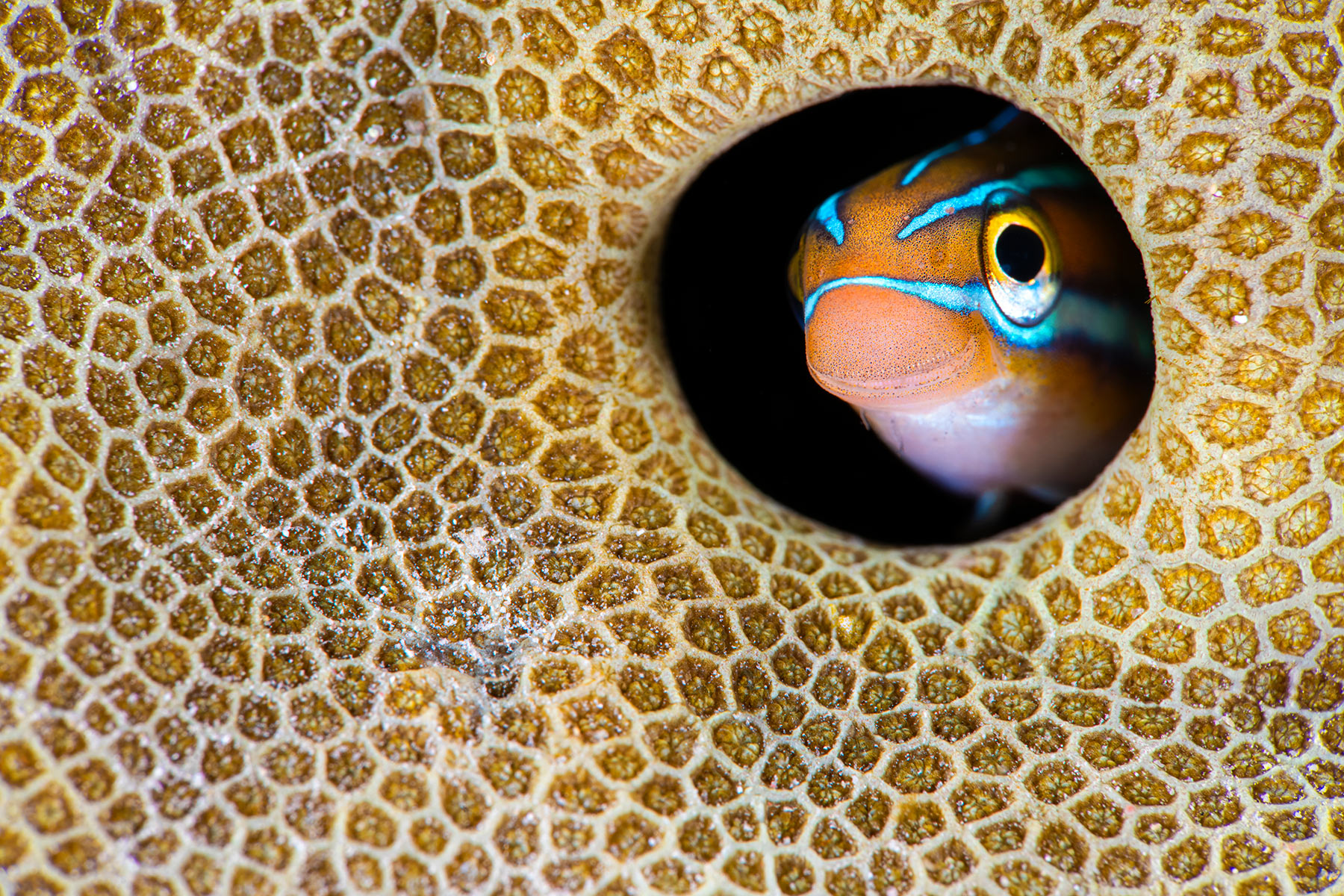
Misool Marine Reserve, Raja Ampat, Indonesia Reef-building corals create habitat for a multitude of species, sometimes quite literally in the case of this bluestriped fangblenny.
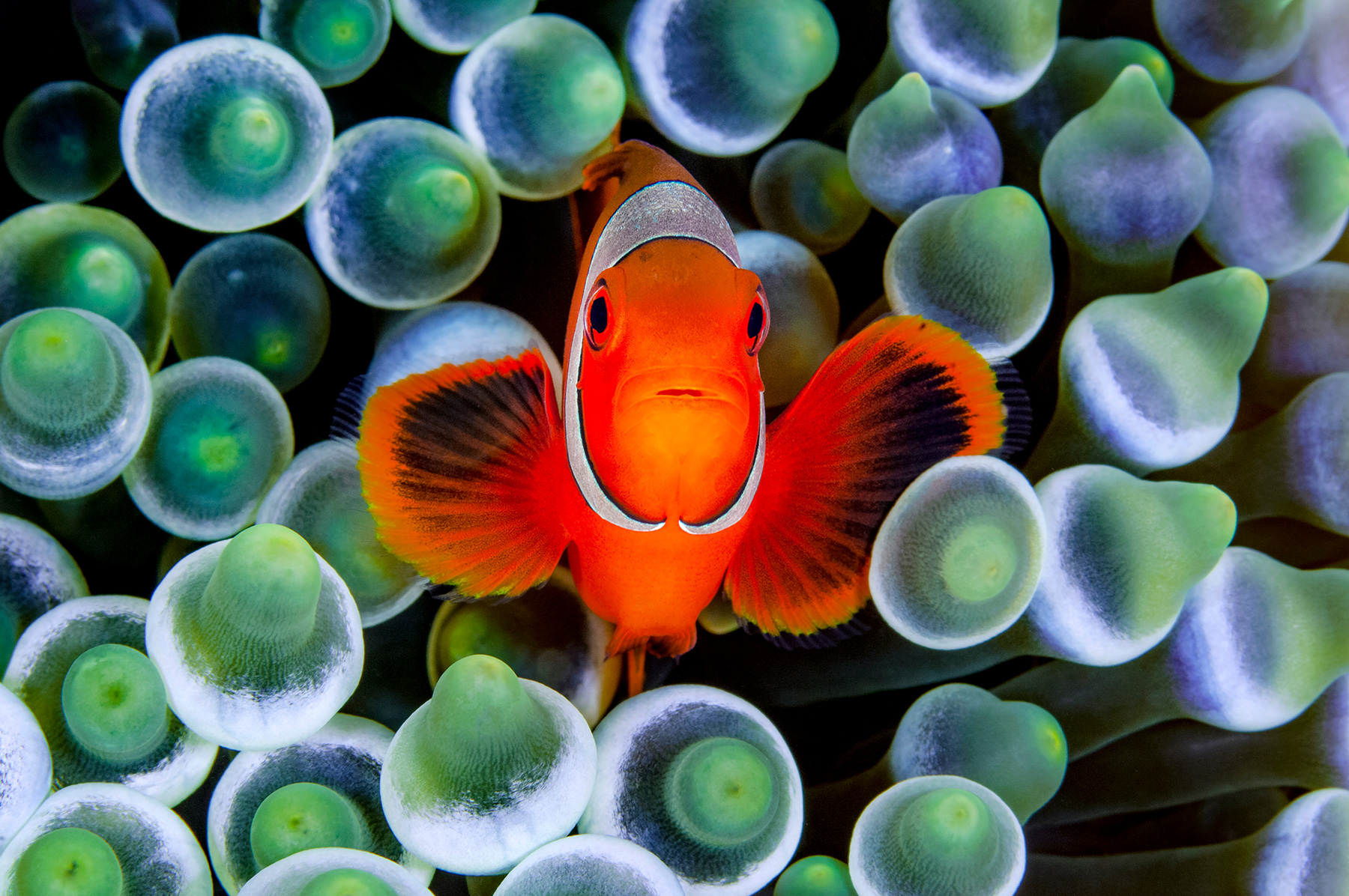
You may have also heard reefs called “cities in the sea,” which I do think is apt. The structure, the different jobs, the density of life, the rush hours, and the relationships are as intricate as any urban web. Few species characterize reef life more than anemonefish. The well-known anemonefish live among the stinging tentacles of sea anemones, coating themselves in anemone mucus, preventing stings while they defend, clean, and even feed their hosts.
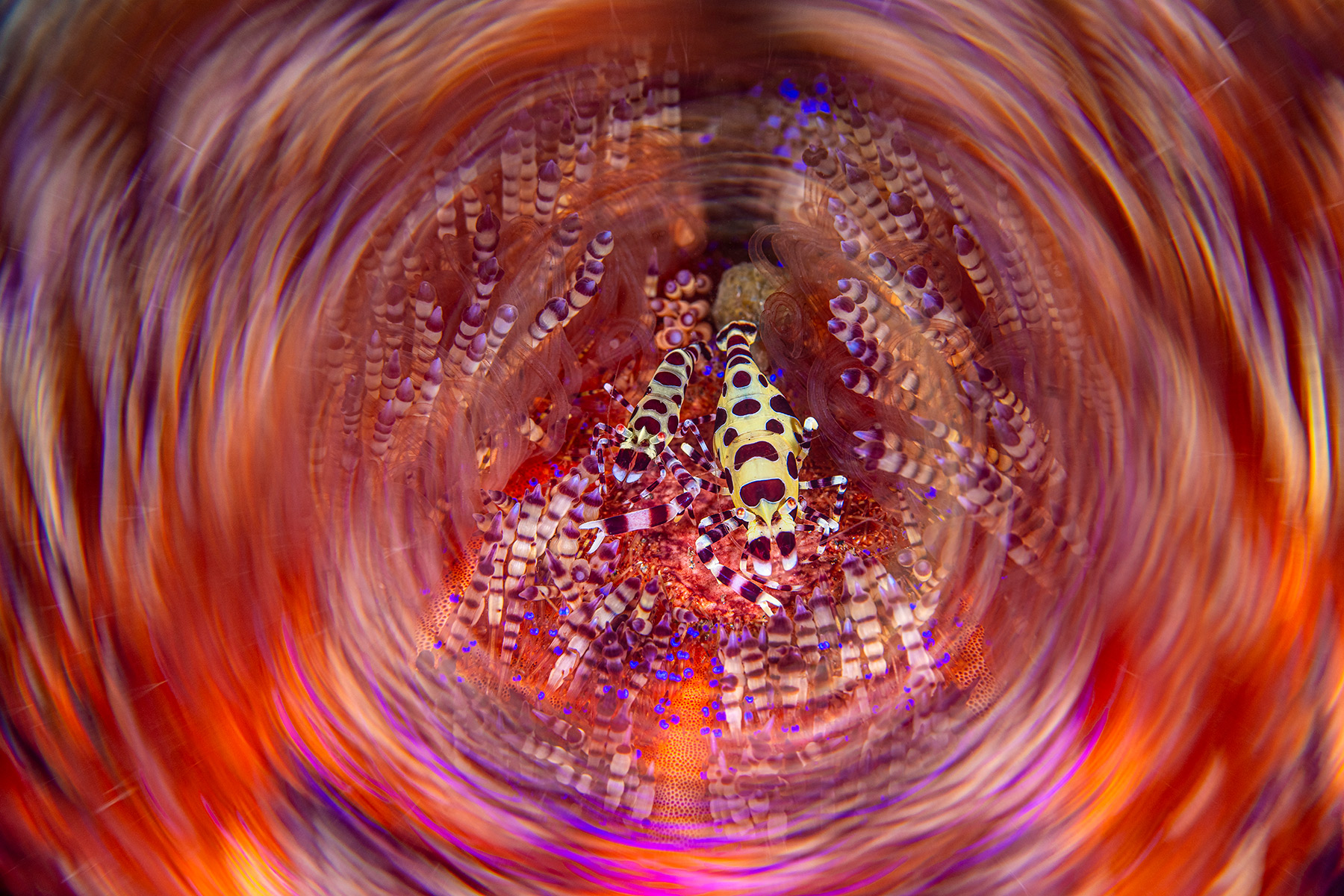
The Coleman’s shrimp spends its adult life on a single spot on a fire urchin. The shrimps, usually found in mated pairs, create a postage-stamp patch cleared of urchin spines, benefiting from the host’s venomous nature to repel predators. Both are classic examples of symbiosis or “living together,” where two different species form a close, long-term interaction.
Misool Marine Reserve, Raja Ampat, Indonesia Out of 1,000 species of anemone, only 10 anemone host anemonefish. While there are 28 species, of anemonefish, this spinecheek only lives in one species, the bulb tentacle anemone.
These relationships, which often evolve together, can be beneficial, harmful, or neutral for each of the organisms involved. It’s easy to see how reefs invite such specialization. The habitat and biological complexity create the opportunity, while the stability of these habitats provides the time for commitment.
A Changing Planet
But times are changing. One hundred and fifty years ago, there were a billion humans on Earth, the majority living unmechanized lives. Since then, human numbers have swelled eight times, with each of us leaving a much heftier footprint on the natural world. “Biomass,” the weight of life, is a term used to understand the importance of animal groups in an ecosystem. It allows us to compare lots of small ones to a few big ones. There are 6,500 species of mammals on Earth. In biomass terms, wild mammals account for just 5%. Ninety-five percent of mammal biomass is humans and our livestock. It’s little wonder that our activities are having such a profound impact on Mother Nature.
Lembeh Strait, Sulawesi, Indonesia Even the most unappealing niches, such as the warning-red, venomous spines of a fire urchin, can make the perfect home for a pair of Coleman shrimp.
Reefs Under Pressure
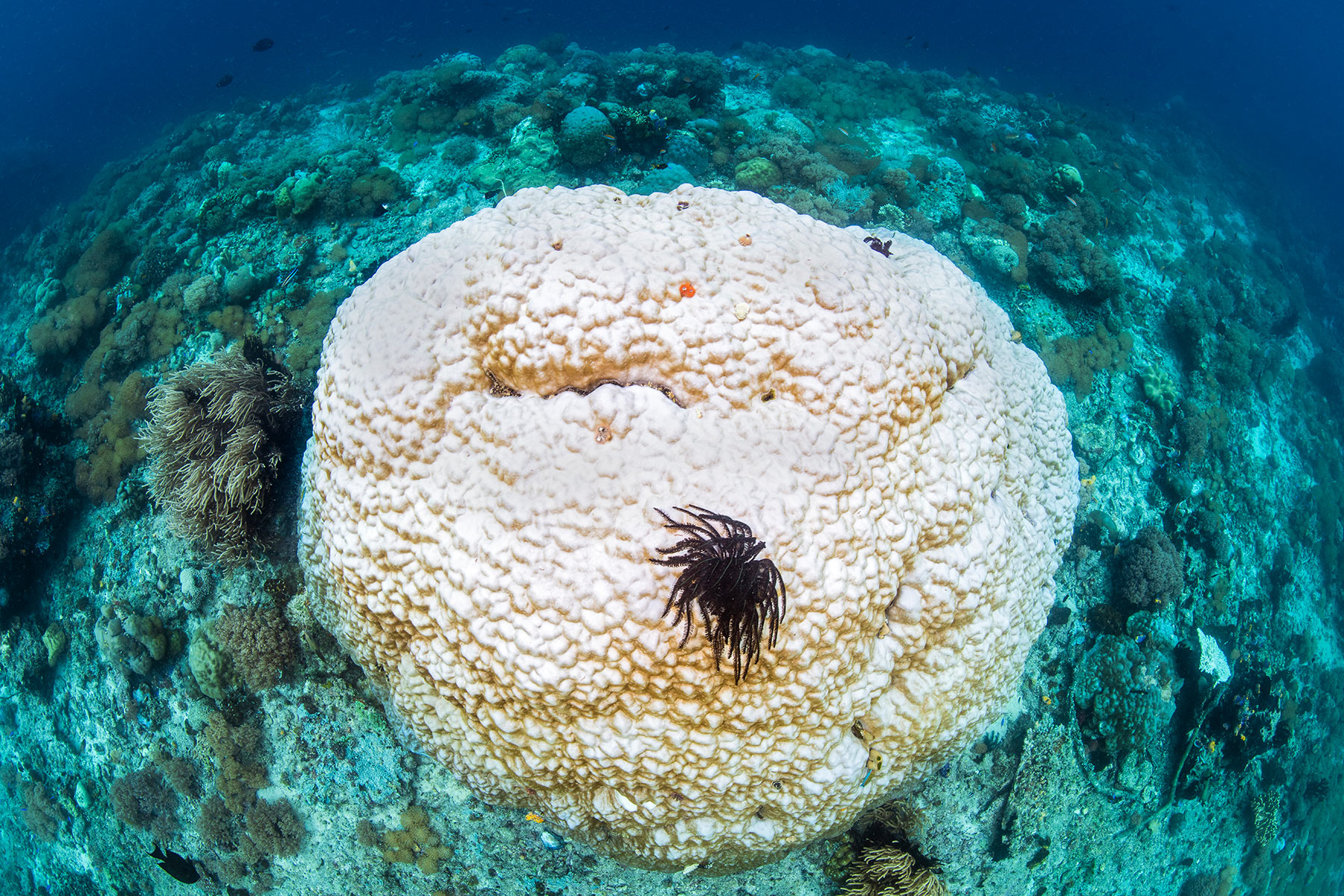
Coral reef systems are under threat, however, and nearly every challenge facing reefs starts with us humans. A warming planet pushes corals beyond their thermal limits. Prolonged heatwaves sever the coral–algae partnership and leave colonies bleached, vulnerable to disease, and starved to death. Ocean acidification reduces carbonate saturation, making it more difficult for corals to build reefs. Pollution and sediment from coastal development smother polyps and feed algal blooms while overfishing removes grazers and predators, eroding the ecological balance. Even escaped pets can wreak havoc, such as the invasive lionfish that have become super-predators on Caribbean reefs.
Misool Marine Reserve, Raja Ampat, Indonesia A massive and old stony coral colony bleached in unusually hot water. Happily, this colony recovered. Critical to its recovery, the colony was healthy and free of other stressors in a well-managed protected area, allowing it to grow back.
Global studies found that from 2009 to 2018, reef systems lost about 14% of their living coral, driven by mass bleaching events and local stressors. Sadly, in 2009, the reefs were already significantly degraded, so to degrade by 14% is significant. Scientists warn that if the Earth’s warming continues, up to 90% of coral reefs may disappear by 2050.
Hope From Apo Island
Yet, against these pressures, individuals and communities are standing up and making a difference. The Philippines lies in the heart of the Coral Triangle, the region that supports the richest coral reefs. This same small archipelago is also home to over 100 million people. Until the early 1980s, Apo Island was fished heavily, using destructive methods such as dynamite, cyanide, and muro-ari, a practice where fish are driven into a net by beating the reef with rocks and ropes. These methods don’t just remove the fish, but they damage the very ecosystem that supports them; it’s like harvesting oranges by chopping down the trees each year.
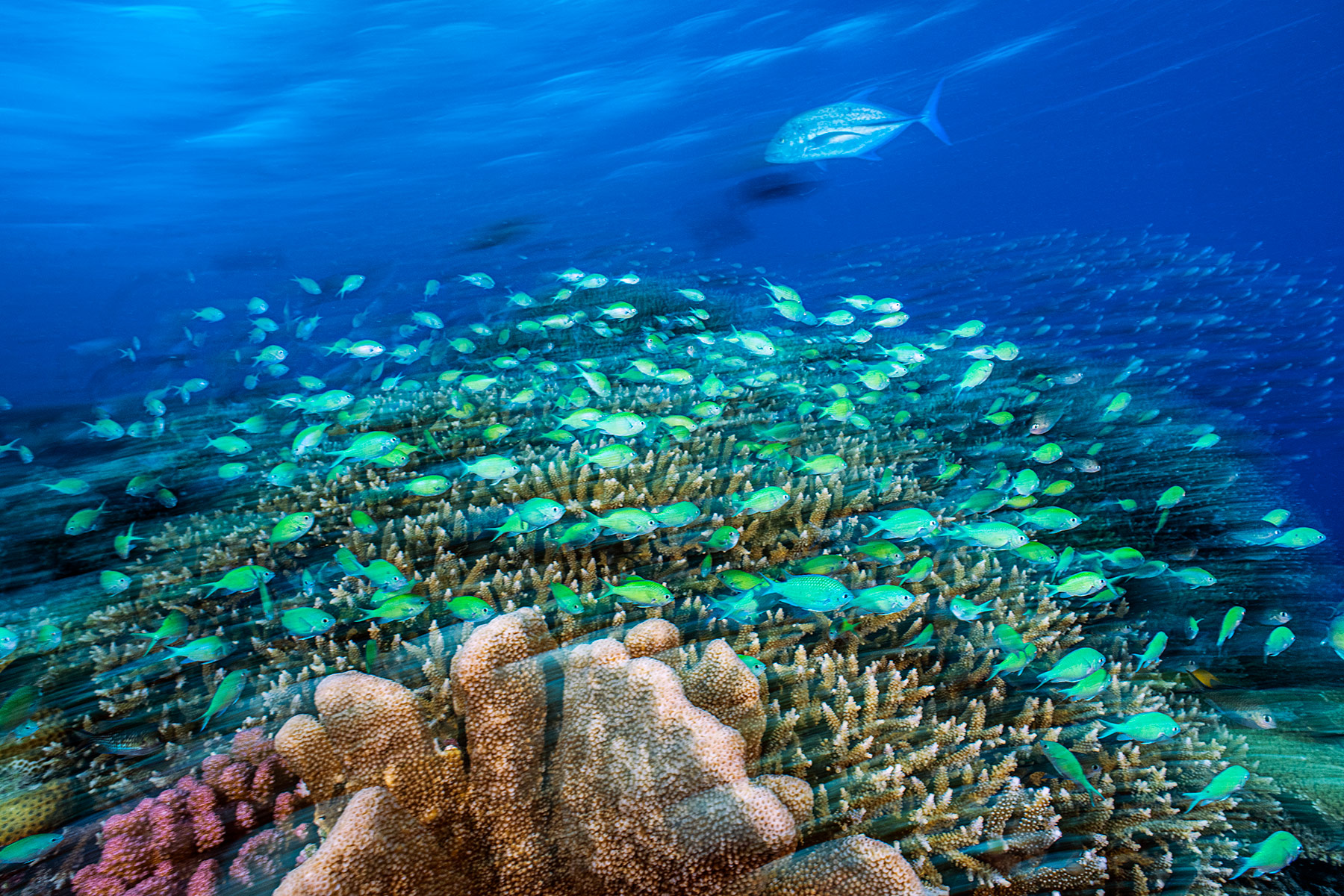
Tubbataha Reefs Natural Park, Philippines Many reefs are under the thumb of human pressures, and it’s easy to collectively forget how they thrum with life when given the protection to thrive. A trevally harasses clouds of axil-spot chromis, waiting for one to misstep and fall prey.
I mention Apo Island because this was one of the first reefs to course correct. In 1982, A biologist convinced the community on Apo Island to fully protect a portion of their reef. Dr. Alcala took Apo residents to other island reefs to show the islanders how rich, healthy, and bountiful reefs could be.
The Apo islanders agreed to create protected marine areas, and it took a few years to have an impact, but by 1988, corals and fish were recovering fast. By 1993, the number of large predatory fish had increased, signifying a healthy reef ecosystem. The islanders benefitted from a “spillover” effect, with fish abundance carried beyond the protected section of the reef. After years of reef protection, even the inherently pessimistic fishermen admitted they were now catching twice as many fish as a decade earlier, and they also benefited from tourism income.
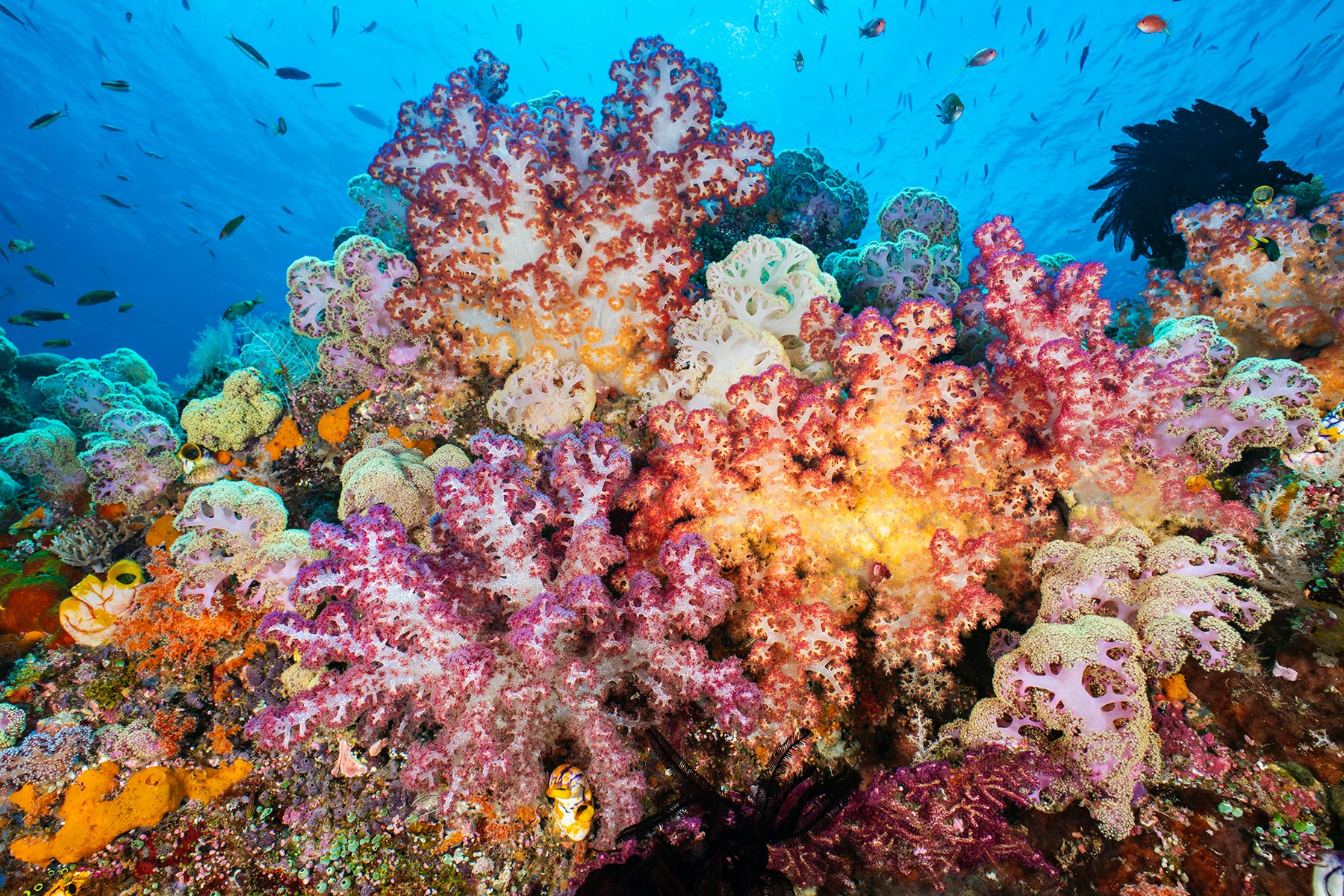
Misool Marine Reserve, Raja Ampat, Indonesia Reef real estate is never wasted in the heart of the Coral Triangle. Multiple genera of soft corals explode out into the current to strain passing morsels of food.
Raja Ampat’s Revival
For many of us, the coral realm reaches its zenith around a cluster of islands in Indonesia’s far eastern corner, better known as Raja Ampat. The word “pristine” is often used, although it wasn’t untouched when I first visited 20 years ago. But even back then, it was easy to conclude that these were the most spectacular reefs I’d ever seen, with perfect coral growth like a spring garden and fish galore.
One of only a handful of places in the universe where biodiversity is improving rather than declining.
There are a lot more divers now, but far more noticeable is that there are a lot more fish, turtles, rays, and sharks. I didn’t see a single shark or manta on my 2006 trip, as the area was fished and targeted by shark-finners. These days, almost every dive yields reef sharks (greys, whitetips, or blacktips) and hammerheads, threshers, and even tiger sharks are spotted from time to time. And it’s now arguably the best place in the world to see manta rays. An upward trend is rare anywhere in the oceans, but that it’s happening in arguably the epicenter of biodiversity is extraordinarily encouraging.
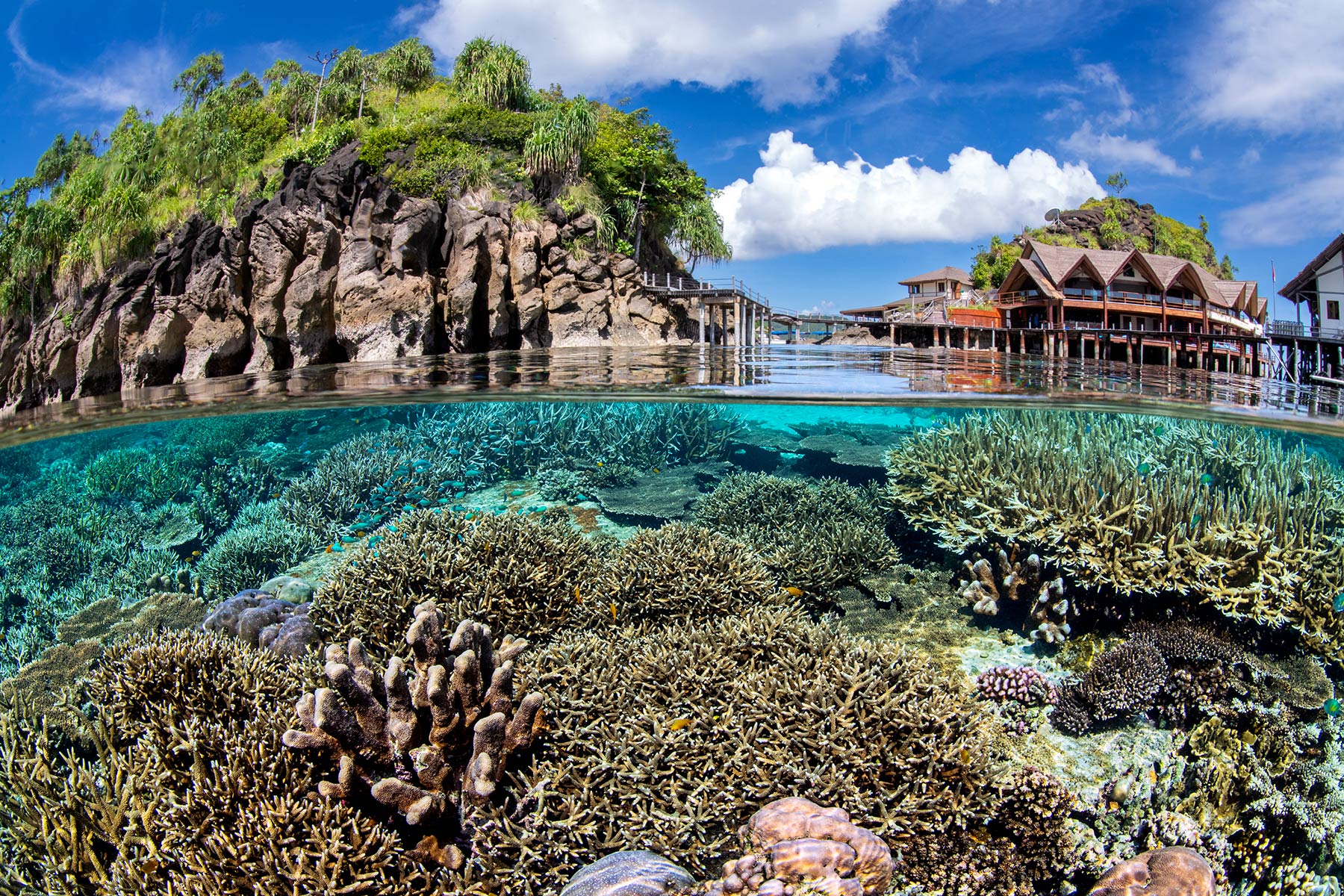
Misool Marine Protected Area, Raja Ampat, Indonesia Coral reef — two words, but a huge variety of species, a DNA databank, food source, vacation wonderland, and robust coastal protection. All jobs they do best when they’re thriving.
What’s the secret formula? There’s no magic, just sound marine conservation. When Marit and Andrew Miners founded Misool Resort in 2005, they had the foresight to co-create a 300,000-acre marine protected area (MPA), funded by the resort and employing a team of 15 rangers from local villages. Scientific surveys show fish biomass increased by an average of 248% between 2007 and 2021, while baited‐video data indicate shark numbers up 190% since 2012. “Misool represents one of the most pristine reef systems left on earth,” comments coral reef ecologist Dr. Mark Erdmann. “One of only a handful of places in the universe where biodiversity is improving rather than declining.” Importantly, the success isn’t only ecological but also social. Local people used to live off the reefs, slowly killing them, while now the islanders benefit financially from protecting the reefs.
The Conservation Blueprint
Across the coral realm, MPAs have expanded and matured, often integrating mangroves and seagrasses to protect crucial ecological arteries that carry energy and life between the associated habitats. Time and again, the most effective MPAs are those co‐designed with local stakeholders, with zoning that respects traditional practices and enforcement that builds pride and ownership. Get it right and reef biodiversity rebounds, fish schools thicken, and the benefits flood in.
North Malé Atoll, Maldives Reefs that are protected from exploitation show a bulging in the food chain as it fills out and big fish return. Scientists clearly see that reefs with more fish biomass have less algae and healthier corals.
Despite the ocean’s ability to rebound, conservation isn’t solely about setting aside space; it’s also about tackling root causes. Reducing greenhouse gas emissions is imperative to slow warming and acidification. Improving water quality on land stops pollution and sediments from reaching and suffocating reefs. Ending destructive fishing restores ecosystem function.
The approach is multifaceted and includes protecting herbivores that keep algae in check (parrotfish), safeguarding apex predators (sharks and groupers) that keep balance throughout the food chain and ensuring that reef-building corals are as diverse and healthy as possible to cope with stressors. For coral reefs, biodiversity becomes a form of insurance. In diverse communities, there are lots of reef builders, herbivores, and predators. If one species falter, others can carry the load.
A Lifeline of Diversity
It’s now widely documented that spending time in nature has a measurable health benefit for people, both emotionally and physically. I can’t help but conclude that the wilder the nature, the further away it takes us from our daily lives and the more beneficial it must be.
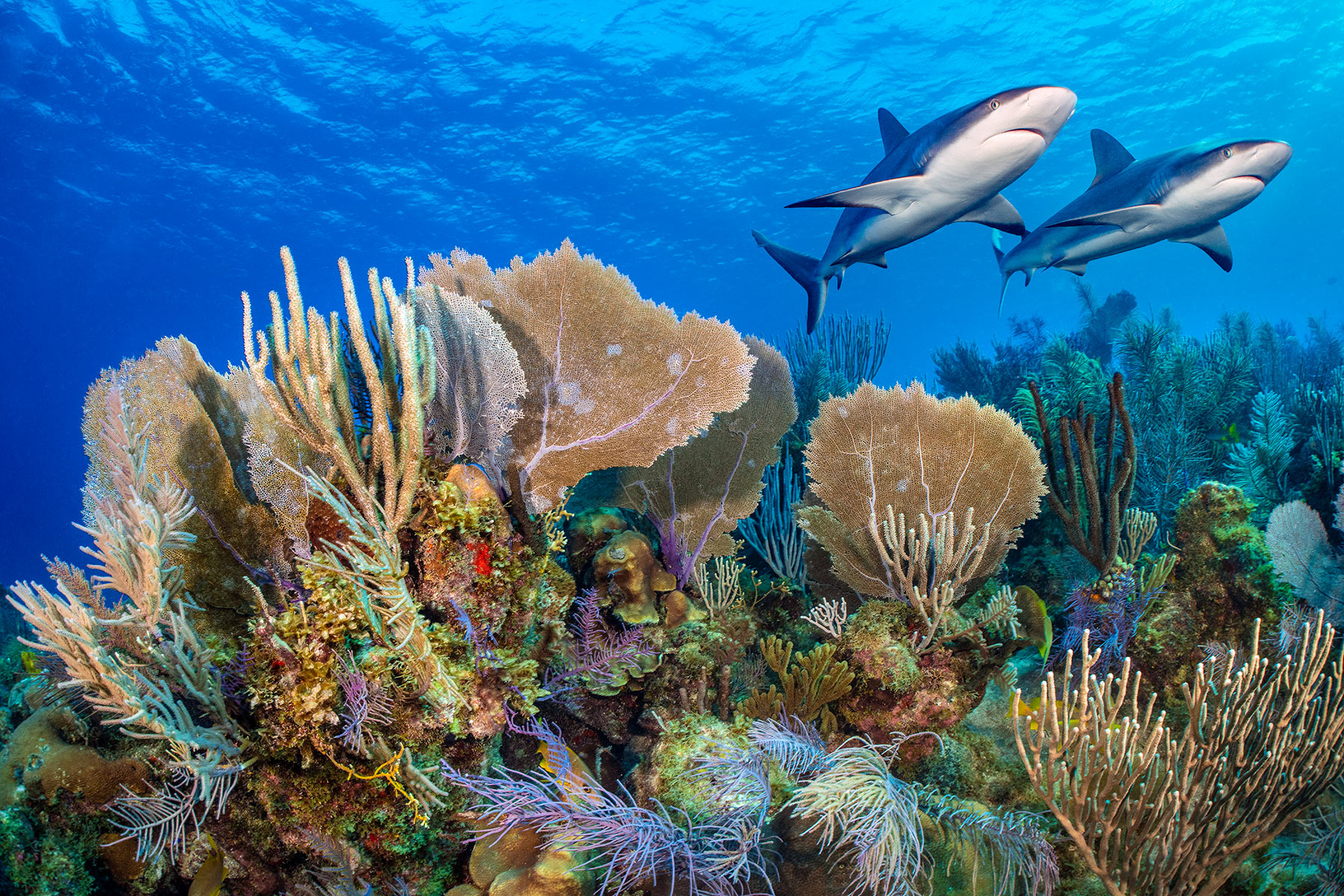
Gardens of the Queen National Park, Cuba Sharks remain in trouble globally, but locally, protection is seeing the magnificent animals reclaim their place as a keystone species in a fully restored ecosystem. Large predatory fish and sharks indicate a healthy reef system.
There’s nothing on land like a coral reef. Diving into reef diversity and witnessing reef life, such as symbiosis, not only enriches our visit, but that biodiversity is also a lifeline to humans and the ocean.
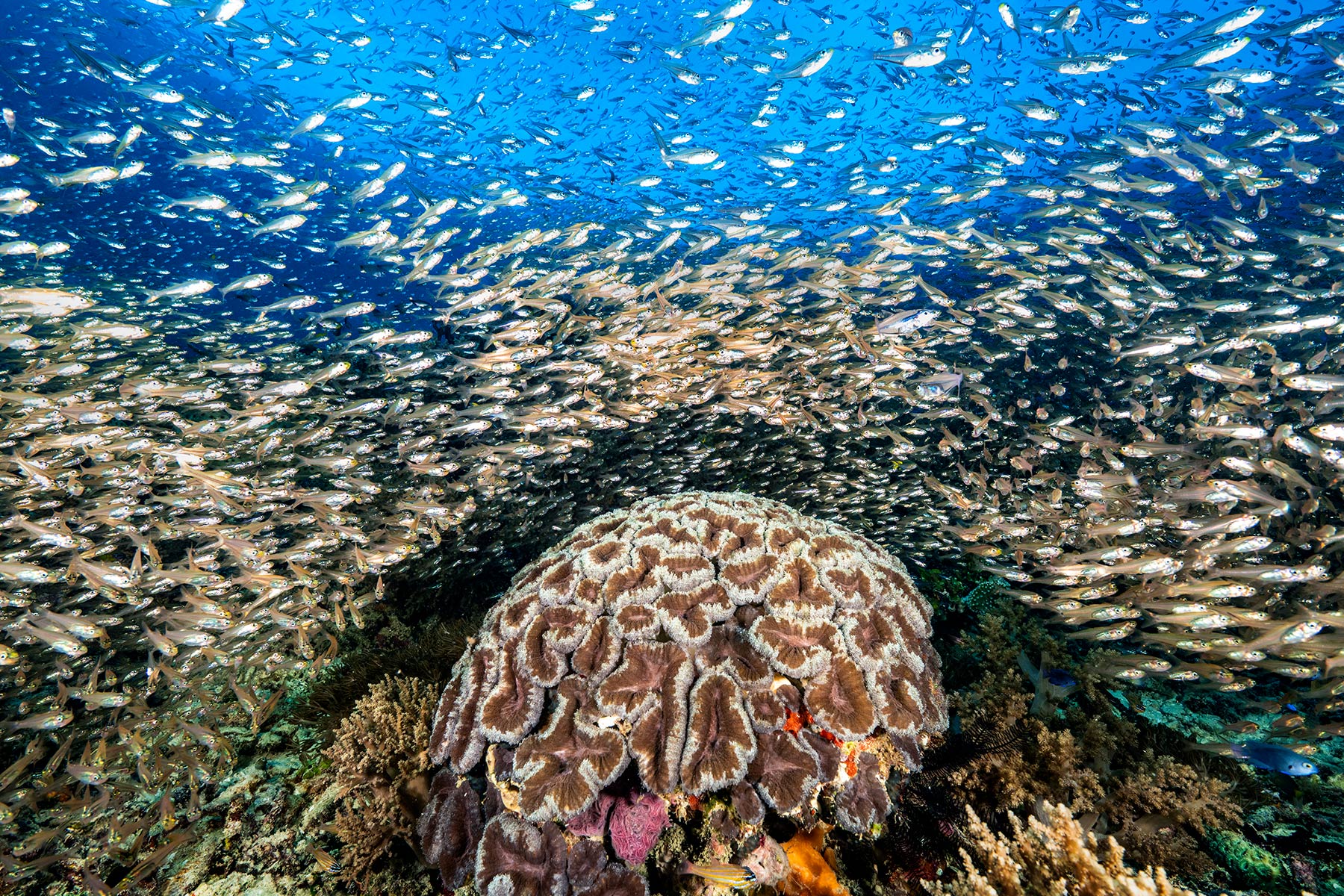
Dampier Strait Marine Protected Area, Raja Ampat, Indonesia Coral reefs are characterized by biological abundance and diversity. Here, thick schools of glassy cardinalfish sweep over a hard coral reef.
To provide the best experiences, we use technologies like cookies to store and/or access device information. Consenting to these technologies will allow us to process data such as browsing behavior or unique IDs on this site. Not consenting or withdrawing consent, may adversely affect certain features and functions.
Functional
Always active
The technical storage or access is strictly necessary for the legitimate purpose of enabling the use of a specific service explicitly requested by the subscriber or user, or for the sole purpose of carrying out the transmission of a communication over an electronic communications network.
Preferences
The technical storage or access is necessary for the legitimate purpose of storing preferences that are not requested by the subscriber or user.
Statistics
The technical storage or access that is used exclusively for statistical purposes.The technical storage or access that is used exclusively for anonymous statistical purposes. Without a subpoena, voluntary compliance on the part of your Internet Service Provider, or additional records from a third party, information stored or retrieved for this purpose alone cannot usually be used to identify you.
Marketing
The technical storage or access is required to create user profiles to send advertising, or to track the user on a website or across several websites for similar marketing purposes.
To provide the best experiences, we use technologies like cookies to store and/or access device information. Consenting to these technologies will allow us to process data such as browsing behavior or unique IDs on this site. Not consenting or withdrawing consent, may adversely affect certain features and functions.
Functional
Always active
The technical storage or access is strictly necessary for the legitimate purpose of enabling the use of a specific service explicitly requested by the subscriber or user, or for the sole purpose of carrying out the transmission of a communication over an electronic communications network.
Preferences
The technical storage or access is necessary for the legitimate purpose of storing preferences that are not requested by the subscriber or user.
Statistics
The technical storage or access that is used exclusively for statistical purposes.The technical storage or access that is used exclusively for anonymous statistical purposes. Without a subpoena, voluntary compliance on the part of your Internet Service Provider, or additional records from a third party, information stored or retrieved for this purpose alone cannot usually be used to identify you.
Marketing
The technical storage or access is required to create user profiles to send advertising, or to track the user on a website or across several websites for similar marketing purposes.