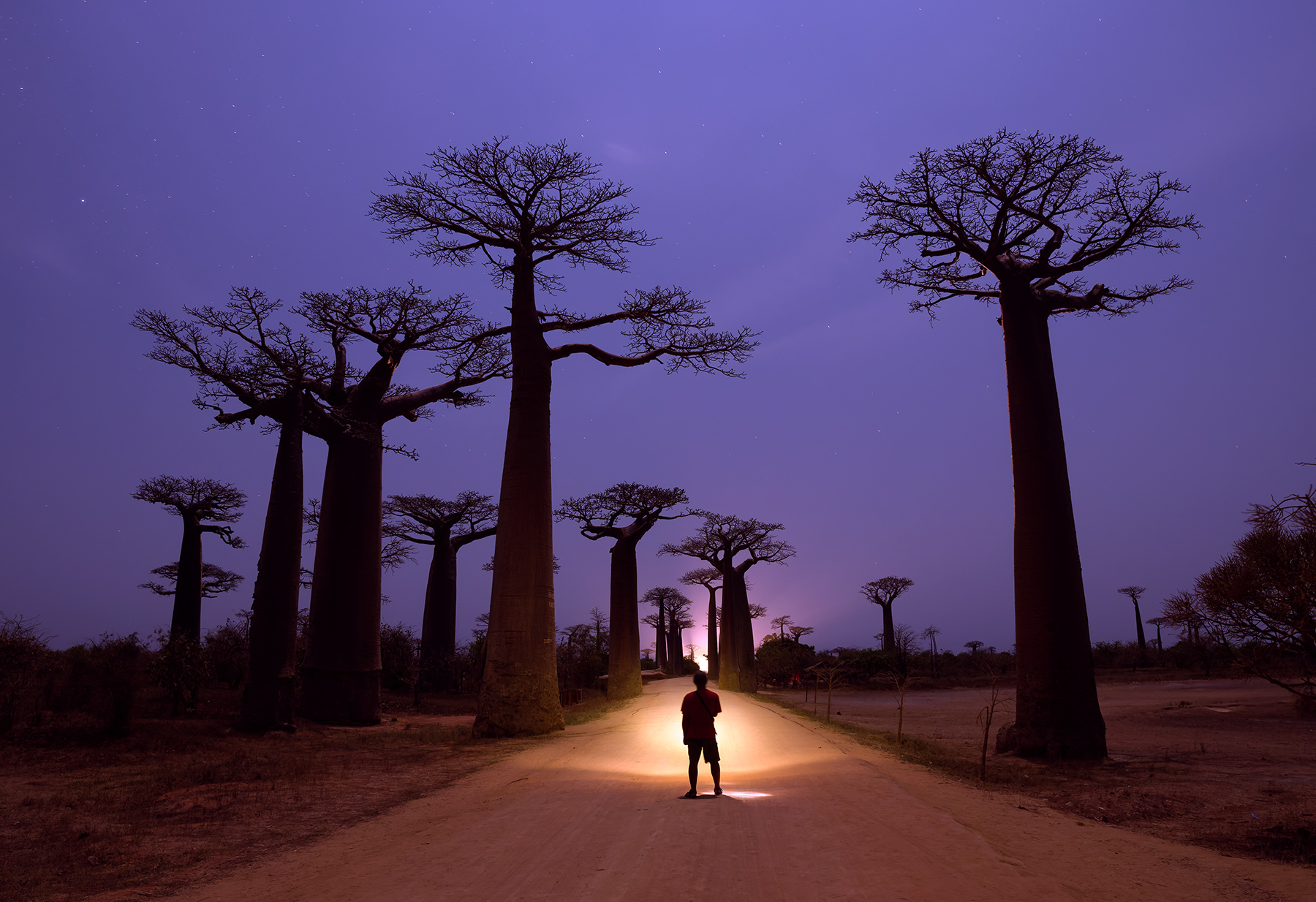
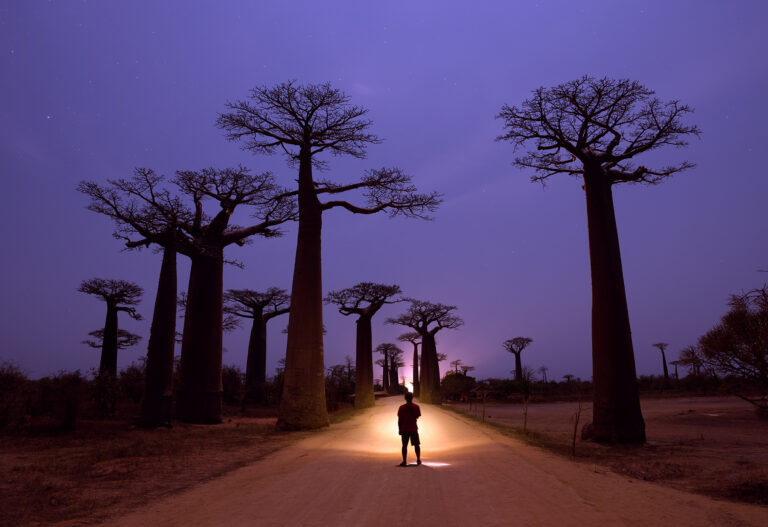
Menabe Region, Madagascar Baobab trees estimated to be 800 years old define the impressive “Avenue of the Baobabs.” This unique natural area deserves better protection and is slated to become Madagascar’s first natural monument, though the trees have been under pressure for years.
↑ Menabe Region, Madagascar Baobab trees estimated to be 800 years old define the impressive “Avenue of the Baobabs.” This unique natural area deserves better protection and is slated to become Madagascar’s first natural monument, though the trees have been under pressure for years.
The Beginning of Madagascar, Africa
Words and Images by Daniel J. Cox
Visiting Madagascar is like turning back the clock. It all began over 160 million years ago when the world’s fourth-largest island began to break away from the massive, ancient supercontinent known as Gondwanaland.
Madagascar’s journey began in two major stages. It first separated from Africa but was still connected to India, Antarctica, and Australia. Then, 90 million years ago, Madagascar broke away from India, becoming the world’s fourth-largest island, settling in the southwest Indian Ocean. And here it has remained where it had prospered as a living laboratory, with over 80% of its animal and plant life evolving in isolation. Those were the good old days.
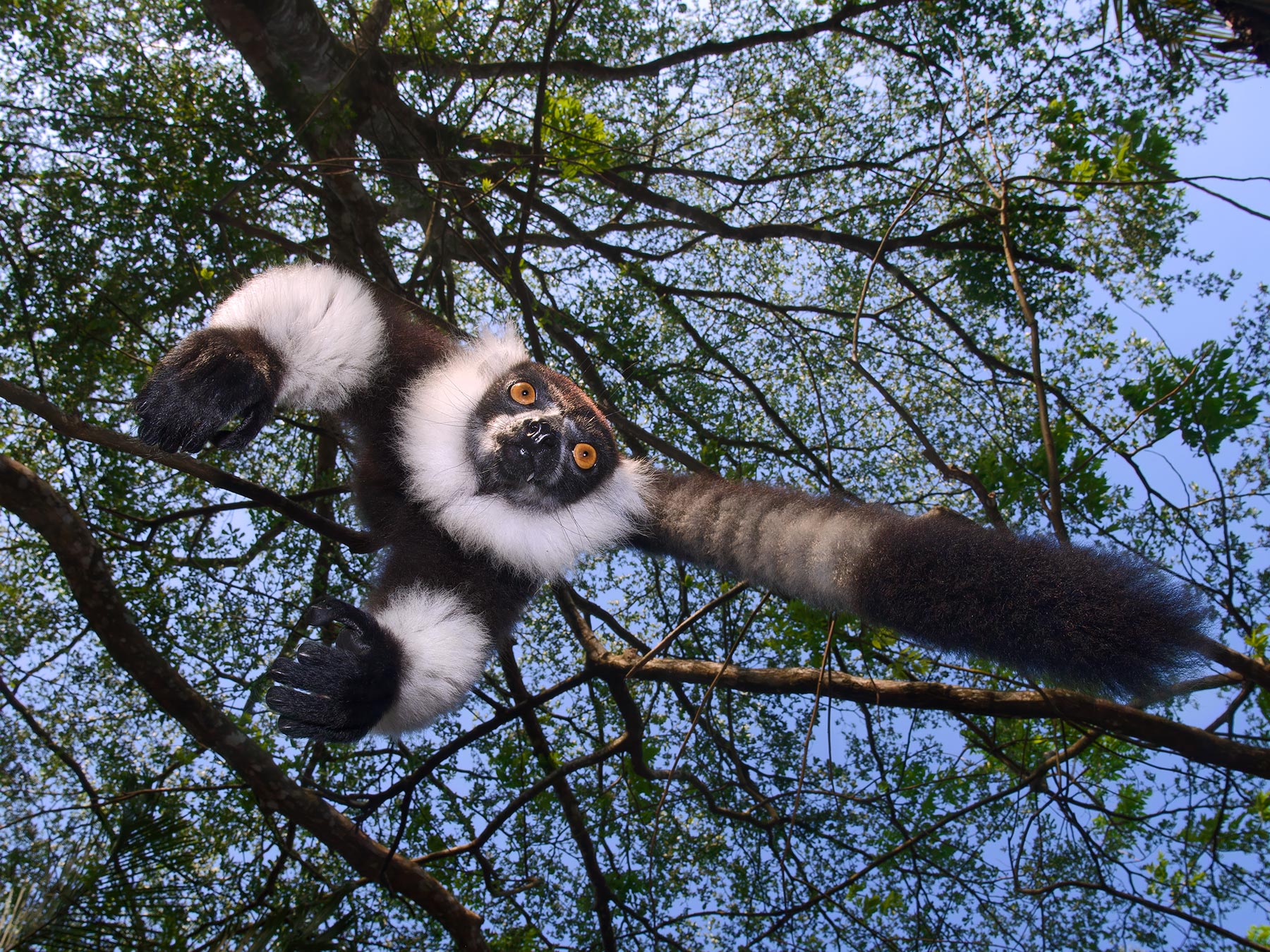
Palmarium Reserve, Madagascar The critically endangered black-and-white ruffed lemur is especially adept at suspending from their feet to help them reach ripe fruit hanging from tall tree branches. These lemurs are highly specialized frugivores with about 75% to 90% of their wild diet consisting of mature canopy fruits.
Madagascar was largely free of human settlement until 350 and 550 AD. The first Austronesian settlers from present-day Borneo were fishermen who reached Madagascar’s shores after traveling over 4,000 miles across the open ocean in advanced outrigger canoes. Several centuries later, Africans crossed the Mozambique Channel to join the Austronesians.
In a relatively short period of time, human settlement has had a radical impact on this island biodiversity hotspot. Roughly 10% of Madagascar’s total land area is strictly protected. These reserves harbor most of the island’s terrestrial vertebrates and plant species. But even protected areas fall under threat of deforestation, which plagues the island. Madagascar has lost approximately 50% to 80% of its original natural forest cover, with large swaths of forest lost annually.
A Biodiversity Hotspot
Thankfully, Madagascar’s unique biodiversity has inspired NGOs from around the world to save what remains of this magnificent island and the animals that call it home. Madagascar’s unique animals — endemic only to this island — the diverse landscape, and even the mass of humanity, are incredibly inspiring. It’s the only place in the world where lemurs are native, boasting over 100 distinct species of these charismatic primates.
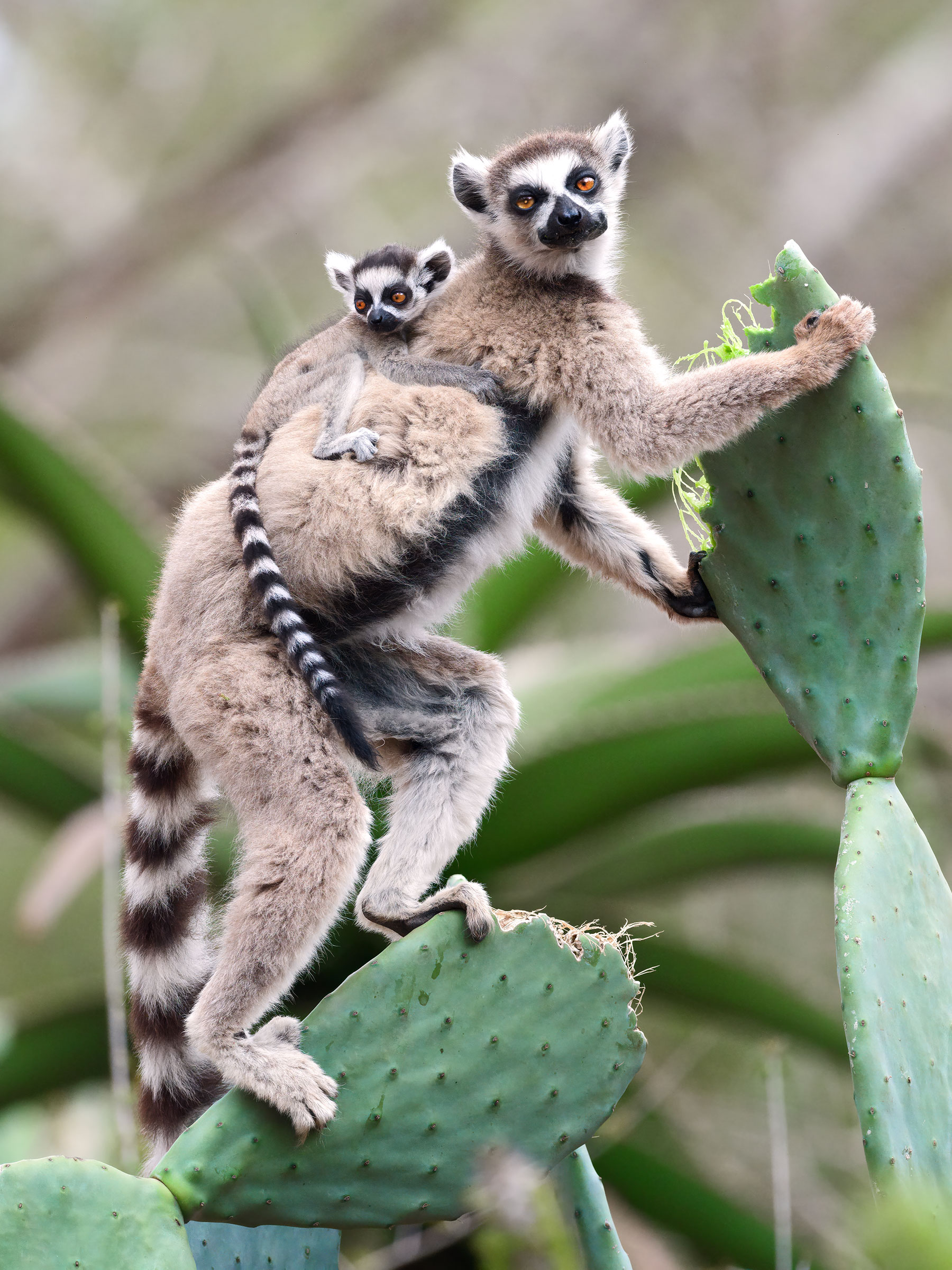
Berenty Reserve, Madagascar An endangered mother ring-tailed lemur, baby clinging to her back, feeds on non-native prickly pear cactus, which was introduced to Madagascar in 1769 by French colonists. The invasive species has profoundly impacted the ecosystem.
I became interested first in documenting the wildlife, but then, recognizing that tourism could be part of the answer to the island’s financial imbalances, I brought workshops to support the island’s tourism industry, demonstrating that natural resources have monetary value.
Madagascar is a landscape and photographer’s paradise with so many interesting things to photograph. The most sought-after subjects, of course, are lemurs, second being chameleons, and third would be the rainforests and their small creatures. My favorite part of Madagascar includes the lower and central part of the country, which is more arid than the north.
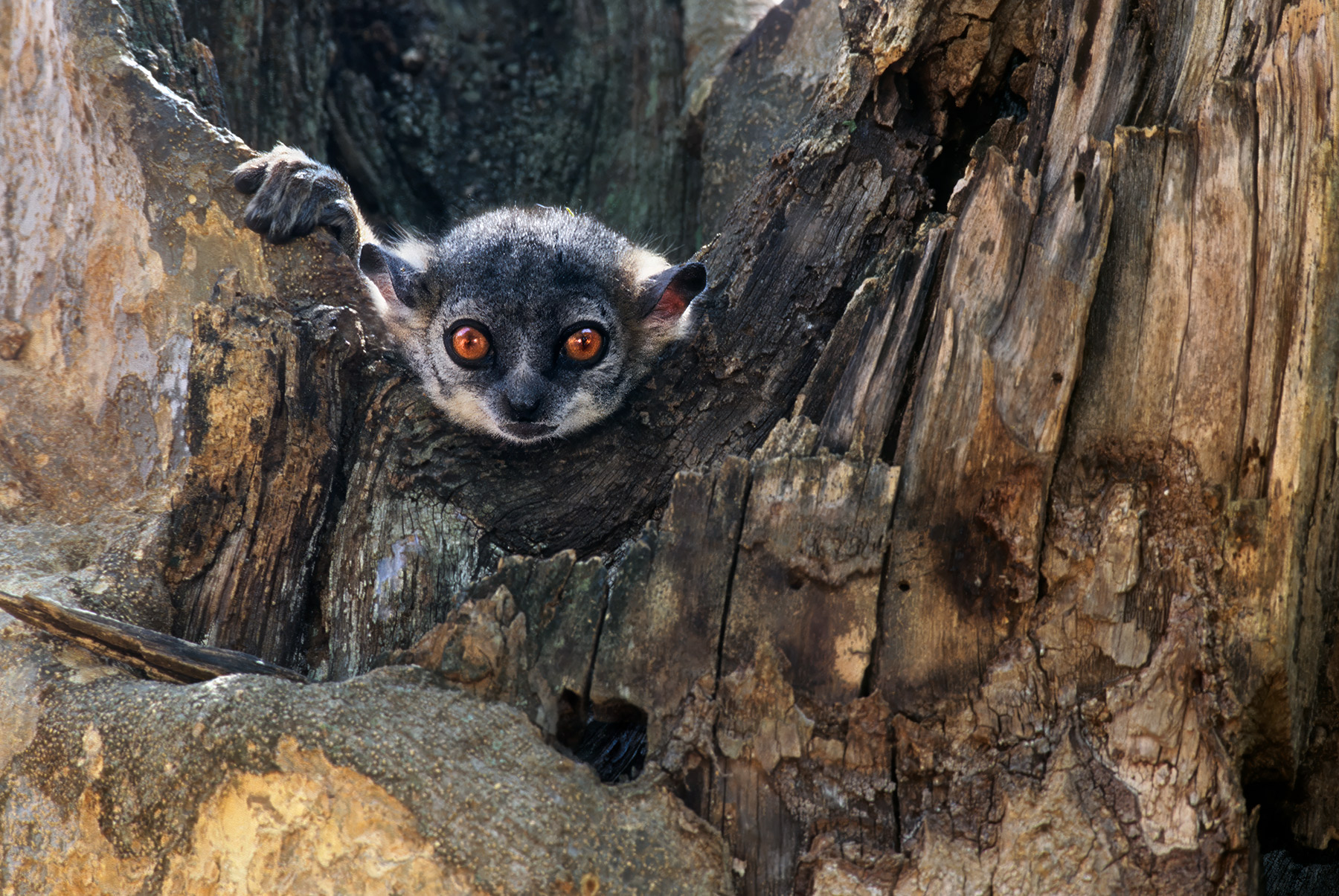
Berenty Reserve, Madagascar The sleepy face of an endangered Petter’s sportive lemur peers out from the cavity of a tree in the spiny forest at dusk. As a nocturnal lemur, this little guy’s day is just beginning. One of the smaller sportive lemurs, this species lives in the spiny and dry forests of Southwestern Madagascar.
My favorite place to start is Morondava, where you can get a feel for the traditional fishing the island is known for. Not far from Morondava is the “Avenue of the Baobabs,” a collection of baobab trees estimated to be over 800 years old. The area is in the process of being designated a natural monument. It’s a wonderful spot to catch fiery sunsets, with the ancient trees silhouetted against the evening sky, creating dramatic landscapes. It’s a popular place, and you’ll have to navigate lots of people.
Of all the places I’ve photographed, Berenty is my favorite. It’s a small private reserve with an intact natural habitat, referred to as a gallery forest, that was set aside by its original landowner for the benefit of local wildlife. Berenty boasts six lemur species and the largest colony of Madagascar fruit bats in southern Madagascar. Along with the gallery forest, you can take a night walk in the adjacent spiny forest, where the evening comes alive with uniquely nocturnal lemurs and other animals.
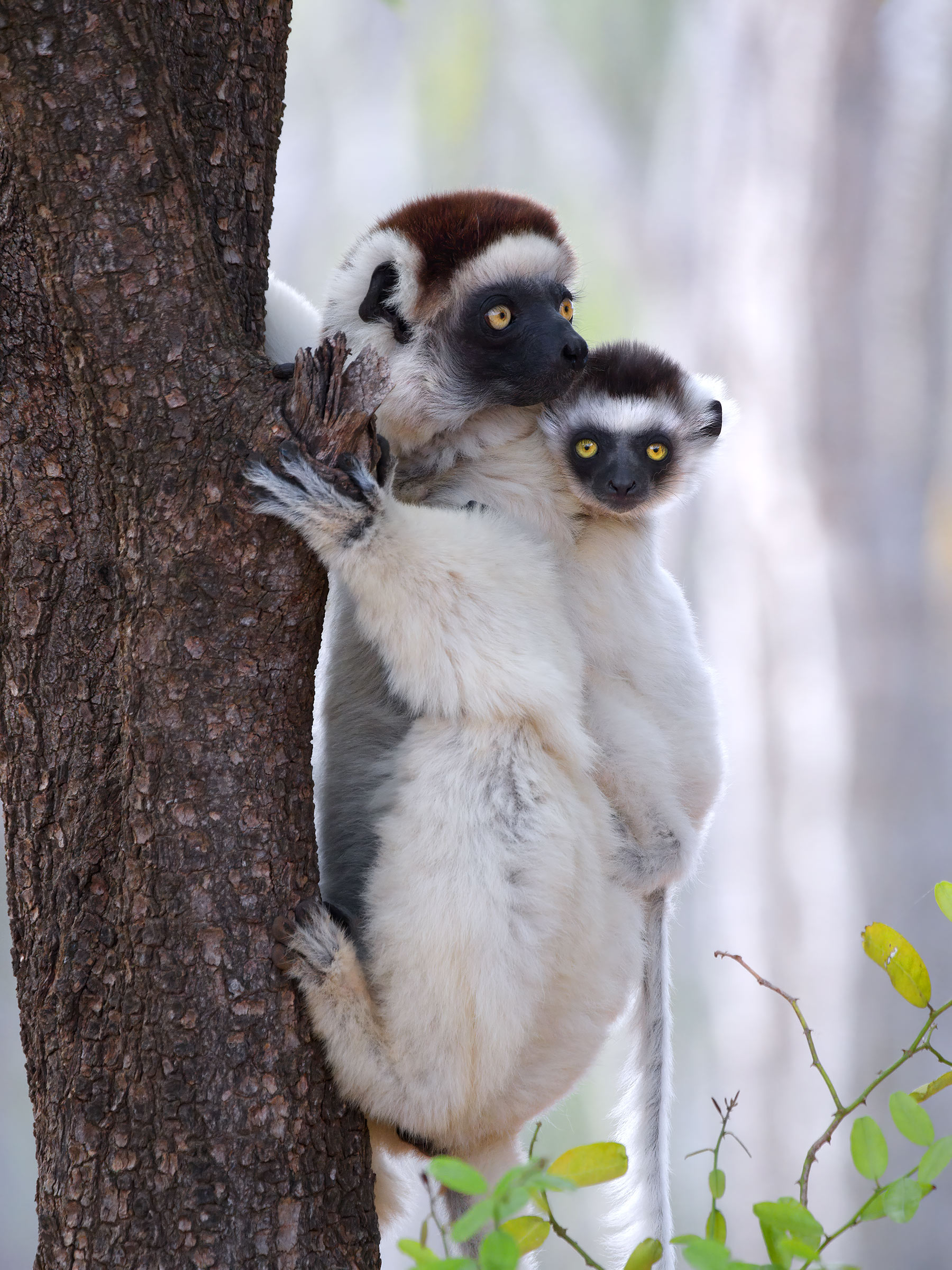
Berenty Reserve, Madagascar A critically endangered baby Verreaux’s sifaka hangs on tight to the back of his mother. These lemurs navigate the trees by jumping from one to the next, sometimes dropping to the ground, where they use their hind legs to hop short distances across forest clearings, open fields, and meadows.
My favorite subjects at Berenty include the Verreaux’s sifaka — a type of lemur — and the ring-tailed lemur. Both are present in substantial numbers. The Verreaux’s sifaka is listed as critically endangered. The other star of Berenty is the ring-tailed lemur. It, too, is endangered. It’s a highly social animal that lives in groups of 3 to 30 individuals, providing opportunities to photograph family portraits and moms with babies.
Next up is the rainforest of Mitsinjo Community Park. This beautiful nature reserve is not far from Andasibe-Mantadia National Park, which is much more popular and therefore more crowded. But both have similar animals for great photography. You can visit Mitsinjo Community Park either day or night, giving you two very distinct experiences. Walking the trails in the day, you can see several species of reptiles, including frogs, chameleons, and geckos. At night, you might see the nocturnal primates, like the fat-tailed dwarf lemur.
Finally, after a 1.5-hour boat ride through the Canal des Pangalanes, the adventure ends along the shores of the stunning Lake Ampitabe. Home to the indri and black-and-white ruffed lemur (both critically endangered), blue-backed reed frog, giant hog-nosed snake, and the otherworldly aye-aye, Lake Ampitabe has several lemur species, but it’s also home to the critically endangered Humbertiodendron saboureaui tree.
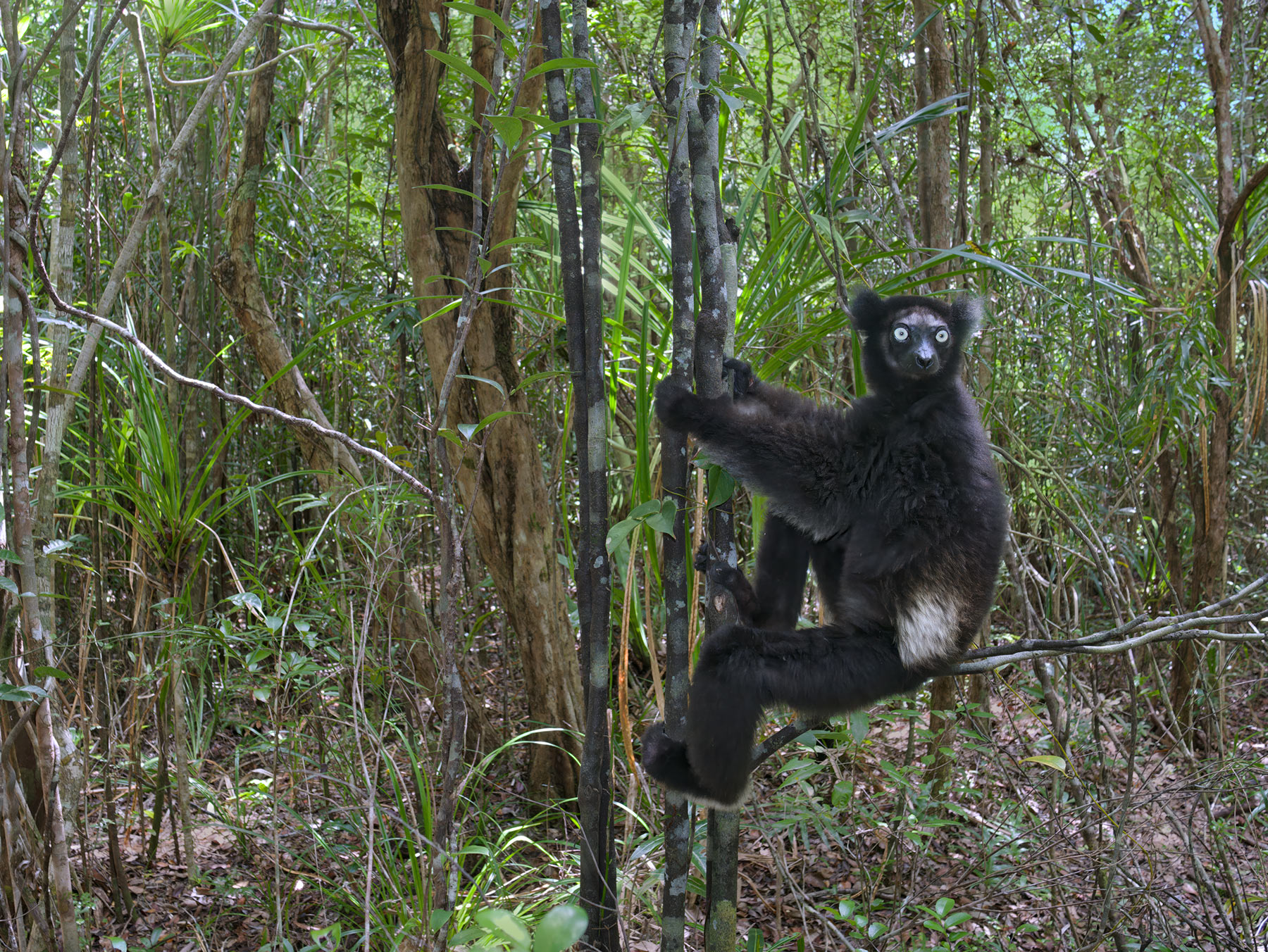
Palmarium Reserve, Madagascar The critically endangered indri is one of the largest living lemurs and is the most vocal of the species. Listening to their haunting whale-like sounds reverberating throughout the forest as the sun begins to set is truly one of nature’s most thrilling evening experiences.
Madagascar is often referred to as the “Land that time forgot,” but with so many unique subjects, forgetting Madagascar seems utterly impossible.
To provide the best experiences, we use technologies like cookies to store and/or access device information. Consenting to these technologies will allow us to process data such as browsing behavior or unique IDs on this site. Not consenting or withdrawing consent, may adversely affect certain features and functions.
Functional
Always active
The technical storage or access is strictly necessary for the legitimate purpose of enabling the use of a specific service explicitly requested by the subscriber or user, or for the sole purpose of carrying out the transmission of a communication over an electronic communications network.
Preferences
The technical storage or access is necessary for the legitimate purpose of storing preferences that are not requested by the subscriber or user.
Statistics
The technical storage or access that is used exclusively for statistical purposes.The technical storage or access that is used exclusively for anonymous statistical purposes. Without a subpoena, voluntary compliance on the part of your Internet Service Provider, or additional records from a third party, information stored or retrieved for this purpose alone cannot usually be used to identify you.
Marketing
The technical storage or access is required to create user profiles to send advertising, or to track the user on a website or across several websites for similar marketing purposes.
To provide the best experiences, we use technologies like cookies to store and/or access device information. Consenting to these technologies will allow us to process data such as browsing behavior or unique IDs on this site. Not consenting or withdrawing consent, may adversely affect certain features and functions.
Functional
Always active
The technical storage or access is strictly necessary for the legitimate purpose of enabling the use of a specific service explicitly requested by the subscriber or user, or for the sole purpose of carrying out the transmission of a communication over an electronic communications network.
Preferences
The technical storage or access is necessary for the legitimate purpose of storing preferences that are not requested by the subscriber or user.
Statistics
The technical storage or access that is used exclusively for statistical purposes.The technical storage or access that is used exclusively for anonymous statistical purposes. Without a subpoena, voluntary compliance on the part of your Internet Service Provider, or additional records from a third party, information stored or retrieved for this purpose alone cannot usually be used to identify you.
Marketing
The technical storage or access is required to create user profiles to send advertising, or to track the user on a website or across several websites for similar marketing purposes.